

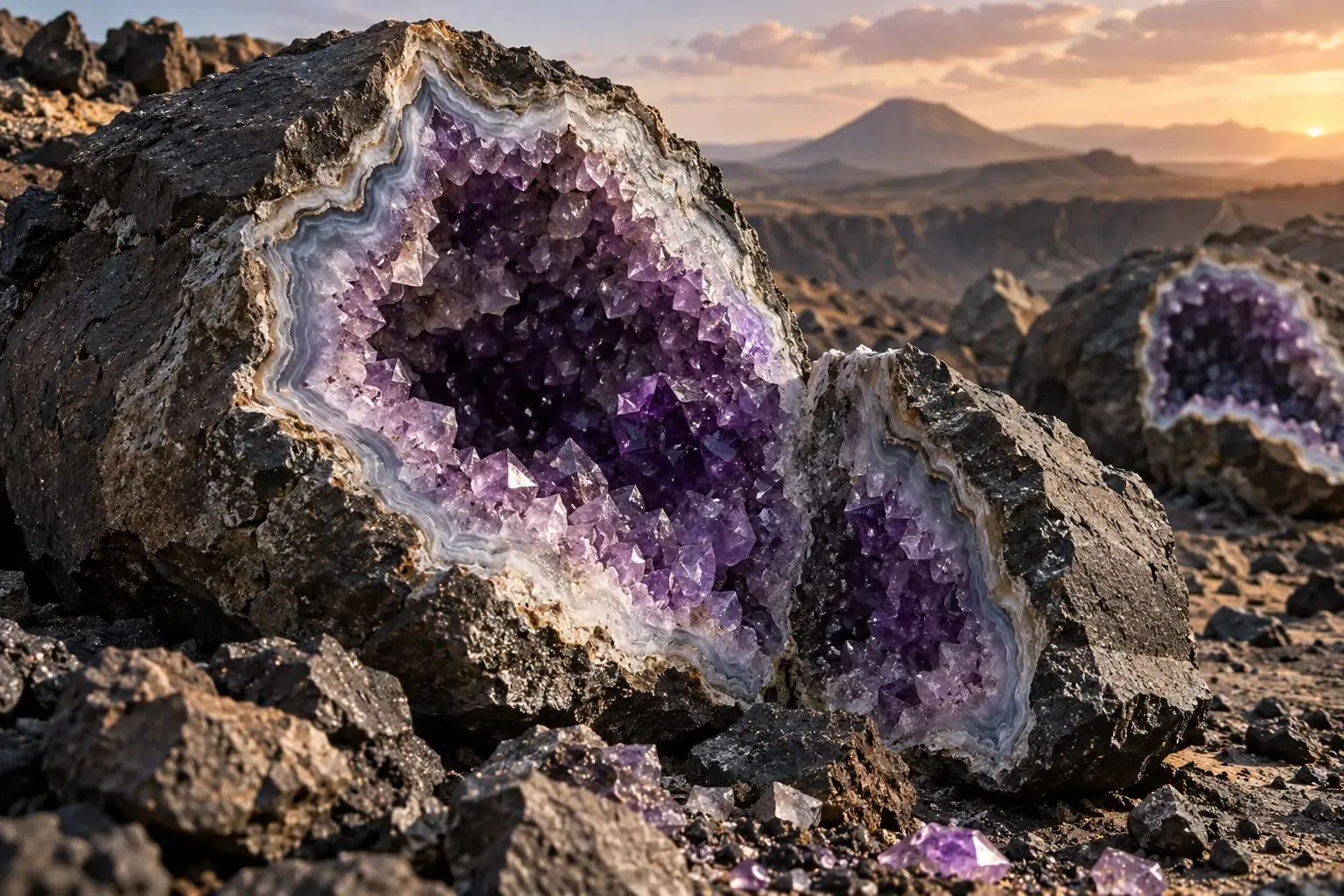
An apparently ordinary rock can hide hundreds of violet crystals inside. That transformation between a discreet mineral exterior and a brilliant cavity is one of the reasons why an amethyst geode is so fascinating.
But how do those crystals get inside a rock? Why is there a hollow space? How long does it take to form?
The answer takes us millions of years back.
What exactly is a geode?
A geode is a rock structure that contains an inner cavity partially or totally lined with minerals.
Its name does not imply that it necessarily contains amethyst.
There are geodes with quartz, chalcedony, calcite and other minerals.
When geological conditions favor the growth of violet quartz crystals on the inner walls, we call it an amethyst geode.
How can there be crystals inside a rock?
To understand it, we must start before the crystals existed.
In volcanic regions, lava can contain gases and generate cavities while it cools and solidifies.
Some of those cavities remain inside the rock.
Much later, fluids carrying mineral components can circulate through fractures and penetrate those spaces.
The minerals then begin to precipitate and accumulate on the inner walls.
With enough time, the layers continue to develop and certain crystals can grow toward the empty space.
The volcanic origin of the geodes of Artigas
Northern Uruguay lies over extensive basaltic formations created by ancient volcanic episodes.
It is within that context that important agate and amethyst deposits appear.
In Artigas, certain cavities in the basaltic rocks offered the necessary space for the later development of mineralizations.
That is why, when observing a geode, we can frequently distinguish an outer layer of rock and different mineral zones before reaching the crystallized area.
The formation process step by step
Although nature does not follow an identical recipe in every case, we can simplify the process to better understand it.
1. Formation of the rock
Lava reaches the surface and begins to cool.
2. Appearance of cavities
Gases and other processes leave spaces inside the volcanic material.
3. Circulation of fluids
Water and solutions with dissolved elements move through the rock and reach certain cavities.
4. Deposition of minerals
The material begins to settle on the inner walls.
Different layers of siliceous minerals may develop.
5. Crystal growth
When free space exists and conditions are favorable, crystals can grow toward the center of the cavity.
6. Formation of amethyst
Under specific chemical and physical conditions, some of those quartz crystals develop the characteristic violet hue.
The final product is what we know as an amethyst geode.
How long does it take for a geode to form?
There is no exact number of years that can be universally applied to all geodes.
These are extremely long geological processes conditioned by multiple variables.
What matters is understanding that the geode we can hold today is the result of natural phenomena occurring on time scales vastly greater than a human life.
Each piece is, literally, a window into the geological past.
Why do the crystals point toward the center?
Crystals grow from the walls of the cavity toward the available space.
When they remain in contact with other materials, their growth is limited.
When they have free space in front of them, they can develop better-defined crystalline faces.
That is why a cavity can appear completely covered by points that seem to point toward its interior.
Why are some geodes bigger than others?
Because the original cavities did not all have the same size or shape either.
In addition, the amount of available mineral material and the growth conditions were different.
There are small geodes that can be held in one hand and far larger pieces.
Size, however, is not the only factor that determines the appeal of a specimen.
A small geode can present extraordinarily defined crystals or a very intense color.
What determines the violet color?
Amethyst is still quartz, but its color is related to small amounts of iron present in its structure and to natural irradiation processes on a geological scale.
The interaction of those factors produces color centers responsible for the violet hue.
Differences in formation conditions mean the intensity is not identical in all stones.
Can a geode contain agate and amethyst at the same time?
Yes.
In certain formations, different layers can be observed before reaching the crystals.
This allows a single piece to show an interesting sequence from the outer basalt to siliceous materials and finally to a cavity with crystals.
This type of structure makes the geode an excellent tool for visually understanding its formation process.
How is an amethyst geode opened?
Pieces intended for display are usually cut with tools appropriate for working rock.
The procedure must be carried out carefully to preserve both the crystals and the desired shape.
After cutting, depending on the presentation, the edges can be worked and polished.
Other pieces are kept with a finish closer to their natural state.
How to choose a geode?
There is no single “perfect” geode.
It will depend on what each person is looking for.
Some elements that can be observed are:
- intensity and distribution of color;
- size and definition of the points;
- luster;
- general shape;
- dimensions;
- state of preservation;
- aesthetics of the cavity;
- presence of particular mineral formations.
In natural specimens, small irregularities should not automatically be seen as defects: many are part of what makes the piece unique.
A natural time capsule
Perhaps that is the most extraordinary aspect of a geode.
The exterior shows us a rock.
The interior reveals a small mineral world that remained hidden for millions of years.
In Artigas, Uruguay, that geological process gave rise to some of the amethyst formations that today identify an entire region.
When a geode is opened for the first time, nothing new is being created.
Something that nature had been building for millions of years is simply being revealed.
Frequently asked questions about amethyst geodes
Do all geodes contain amethyst?
No. A geode can contain different minerals.
Does amethyst grow from the outside in?
The crystals develop on the walls of the cavity and grow toward the available space inside.
Can a natural geode have imperfections?
Yes. Fractures, size variations, inclusions and color differences are common in natural materials.
Do giant geodes exist?
Yes. Some mineralizations can produce formations of large dimensions.
Does Uruguay have amethyst geodes?
Yes. The department of Artigas is recognized for its important agate and amethyst deposits.