

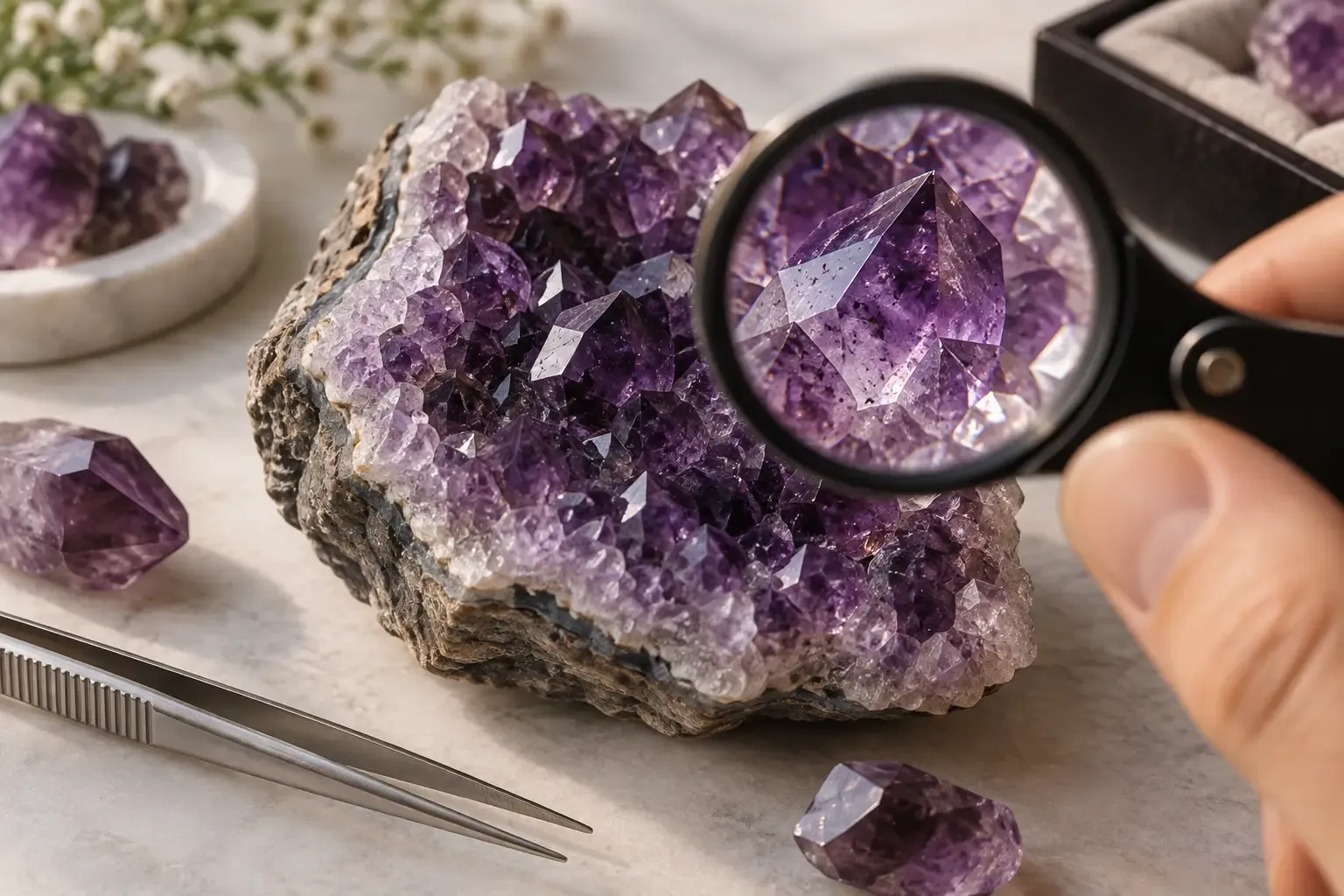
If you are about to buy a crystal, a geode or a piece of jewelry, it is normal to wonder how to tell if amethyst is real.
The enormous variety of products available means you can find natural amethysts, treated quartzes, synthetic materials, colored glass and products whose commercial description is not always sufficiently clear.
There is no infallible home test that identifies absolutely every case, but there are several aspects worth observing.
First: what does “authentic amethyst” mean?
A natural amethyst is violet quartz formed through geological processes.
That is not exactly the same as saying “untreated”.
A stone can be natural in origin and later have received some treatment intended to alter or improve its appearance.
For this reason, it is worth distinguishing between:
- natural: it formed in nature;
- synthetic: it was produced through artificial processes that imitate the mineral’s growth;
- imitation: another material tries to look like amethyst;
- treated: the original material was subsequently modified.
This difference matters when asking the seller.
1. Observe the natural color variations
Many people imagine that a good-quality amethyst must have an absolutely uniform violet color.
Not necessarily.
Natural crystals can show tone shifts between different areas of a piece.
In a geode, moreover, it is common for some points to differ from others.
Natural variations can be a sign consistent with geological origin, although by themselves they cannot guarantee authenticity.
2. Look for inclusions and irregularities
Nature rarely produces visually perfect objects.
An amethyst can contain:
- small inclusions;
- zones of different transparency;
- internal lines;
- microfractures;
- variations between crystals.
In a complete geode, this complexity is even more evident.
However, we should not apply an overly simplistic rule either.
A natural gemstone can be extraordinarily clean, while an artificial material can incorporate features designed to make it look natural.
3. Observe the structure when it is a geode
In a natural geode we should not think only about the crystals.
The complete structure can show several zones: outer rock, different mineral layers and finally the crystallized cavity.
That transition provides information about the formation of the piece.
Geodes from basaltic regions such as Artigas can clearly preserve that mineral context.
4. Be wary of claims that are too perfect
An incredibly low price combined with a supposedly exceptional piece always deserves a second look.
This does not mean that an inexpensive amethyst is fake.
Value depends on many variables: size, color, origin, quality, work done on the stone, market and presentation.
The recommendation is to evaluate the whole and not a single characteristic.
5. A photograph is not always enough
Photographs can considerably modify the perception of color.
Lighting, the camera, white balance, image processing and the screen we view them on can make a crystal look more bluish, reddish, dark or saturated.
For that reason, when buying online it is advisable to have clear photographs from several angles.
For pieces of a certain value, a video can offer even more information.
6. Ask about provenance
Knowing where an amethyst comes from adds relevant information.
Brazil, Uruguay, Zambia and other regions produce amethyst with characteristics that can vary.
In Uruguay, Artigas is the reference area for agates and amethysts.
Documented provenance does not replace gemological identification when it is necessary, but it provides traceability and context.
Can synthetic amethyst exist?
Yes.
Quartz can be grown artificially through industrial techniques, and there are synthetic materials that can be very difficult to distinguish from natural ones without specialized equipment and expertise.
This is one of the reasons why “home tests” that promise 100% certainty should be treated with caution.
Can glass look like amethyst?
Yes.
Violet glass can be used as an imitation.
Depending on the object and its manufacture, characteristics incompatible with the natural growth of a crystal may be observed, but determining it correctly requires evaluating the piece.
It is not advisable to break, scratch or subject a valuable stone to destructive tests simply to try to verify it.
Is the hardness test useful?
Amethyst, as a variety of quartz, has a hardness of 7 on the Mohs scale.
In theory, scratch tests can provide mineralogical information.
In practice, we do not recommend performing destructive tests on a finished or valuable piece.
A scratch can ruin a polished surface and, moreover, performing the test poorly can lead to incorrect interpretations.
What about heated amethyst?
Heating can modify the color of certain quartz varieties.
Part of the material marketed under different names may have received heat treatment.
Therefore, if it is important to the buyer to specifically acquire a natural amethyst without known treatments, they should state it and ask expressly before making the purchase.
Is a very dark amethyst necessarily better?
No.
Color influences the appreciation of a gemstone, but darker does not automatically mean better.
The beauty of a piece depends on the combination of tone, saturation, transparency, color distribution, size and overall quality.
In the case of a geode, many other factors are also involved, such as shape, the quality of the points and the composition of the whole.
Signs that deserve further review
None of these characteristics by itself proves that an amethyst is fake, but they can justify asking more questions:
- product description that is too vague;
- a seller who avoids providing provenance or treatments;
- excessively edited photographs;
- claims of authenticity without any additional information;
- a price difficult to reconcile with what is being offered;
- supposedly natural pieces that are identical to each other in every detail.
Professional identification is the option for important pieces
When a rigorous determination is needed — especially for high-value gemstones — professional analysis is the appropriate alternative.
A laboratory or gemologist can use instruments and methods that far exceed what can be achieved through home observation.
This is particularly relevant for differentiating certain natural materials from synthetic equivalents.
Buying with information is better than looking for a “trick”
The best way to acquire an amethyst is not to memorize a single home test.
It is to gather information.
Ask what you are buying, what the declared provenance is, whether there are known treatments and what policies the seller offers.
And remember that in a natural stone, differences are not necessarily imperfections.
They are part of a geological story that no factory can repeat identically.
Frequently asked questions
Does a real amethyst have to have imperfections?
It may have them, but a natural stone can also show very clean areas. It is not a definitive proof.
Does authentic amethyst scratch glass?
Quartz is a relatively hard mineral, but we do not recommend using scratch tests on valuable specimens.
Is there laboratory-made amethyst?
Yes. Synthetic quartz exists, so certain identifications require professional analysis.
Are amethyst geodes natural?
Natural geodes exist, but modified or assembled pieces can also be found on the market. Traceability is important.
Where does Uruguayan amethyst come from?
The main producing region is in the department of Artigas.