

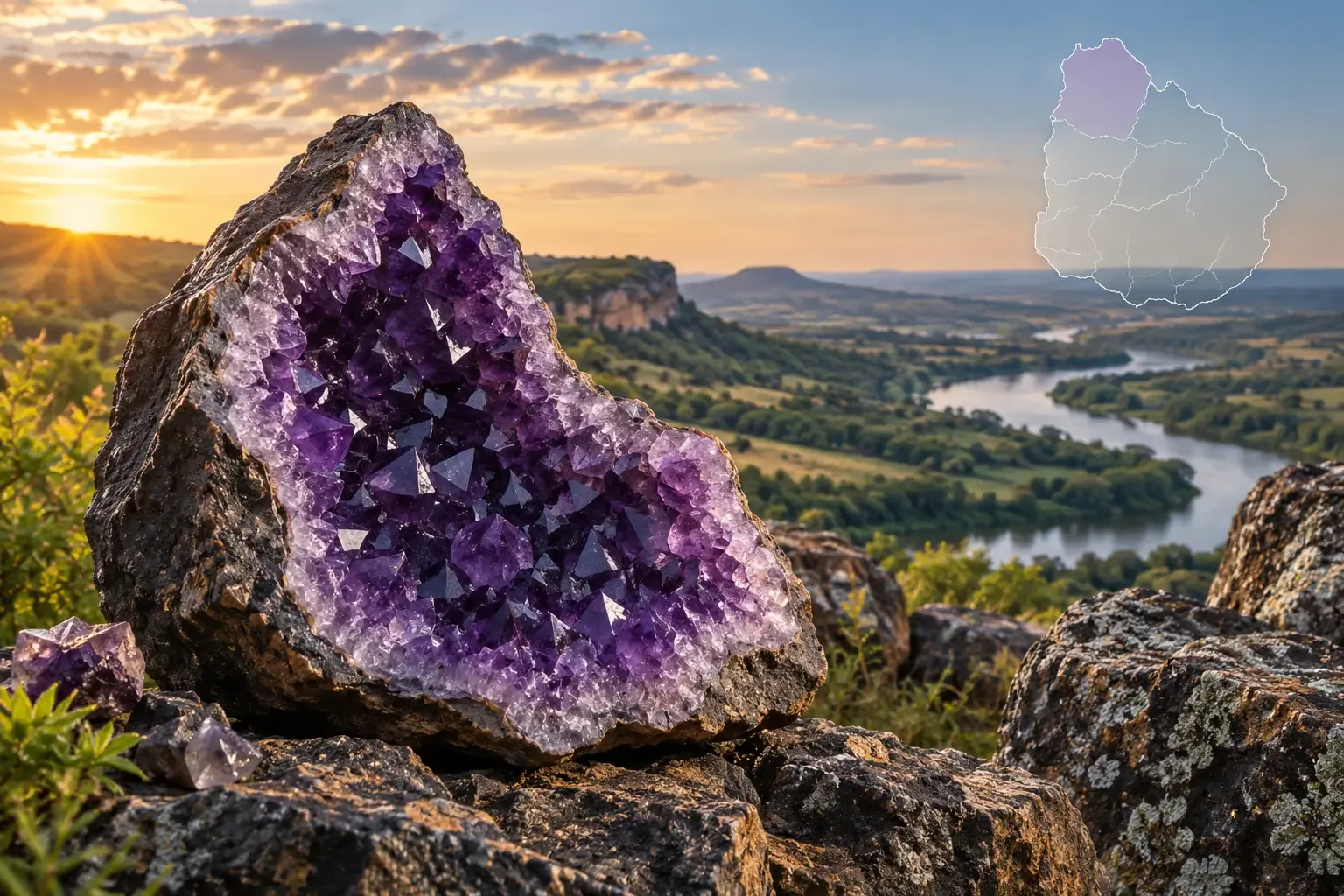
Uruguay amethyst is one of the most representative minerals of the country’s north and one of the stones for which the department of Artigas has gained international recognition. Its intense violet color, the quality of its crystals and the impressive geodes in which it can be found make Uruguayan amethyst a stone especially prized by collectors, decorators, jewelers and mineral enthusiasts alike.
Although amethyst deposits exist in different regions of the world, Artigas amethysts have characteristics that have given them their own identity. To understand what makes them special, one must know their origin, their geological formation and the environment they come from.
What is amethyst?
Amethyst is a violet variety of quartz, one of the most abundant minerals in the Earth’s crust.
Chemically, it belongs to silicon dioxide, whose formula is SiO₂. What visually sets amethyst apart from transparent quartz is fundamentally its hue, which can range from light violets to deep, intense tones.
The crystals develop over long natural processes in cavities within rocks. When conditions are right, those cavities end up internally coated with crystals and form the structures we know as geodes.
In Artigas, many of these geodes are found inside basaltic rocks.
Where is amethyst found in Uruguay?
The main Uruguayan deposits are found in the department of Artigas, in the north of the country and close to the border with Brazil.
The region linked to the Arroyo Catalán basin is especially known for its agate and amethyst deposits.
This is not merely a geological curiosity. The extraction, selection and processing of these stones have been part of the economic and cultural identity of Artigas for decades.
The relevance of this activity is such that Artigas was officially declared the National Capital of Precious and Semi-Precious Stones, Agates and Amethysts.
Why is Artigas amethyst famous?
One of the most prized characteristics of certain amethysts from Artigas is the intensity of their color.
A single geode can contain hundreds or even thousands of violet quartz points facing its inner cavity. Depending on the specimen, you may observe very small, compact crystals or larger points.
Among the attributes usually considered when appraising a piece are:
Color intensity
Violet is one of the first elements that draw attention. An amethyst can show different levels of saturation and natural variations within the same geode.
Crystal quality
The definition of the points, their luster, size, transparency and state of preservation also influence the overall appearance of a piece.
Geode shape
Each formation is different. Some geodes are rounded, others have elongated shapes, and there are also large structures that, once opened, reveal spectacular crystallized surfaces.
Natural contrast
The combination of the rock’s outer matrix, the internal layers and the violet of the crystals makes each specimen unrepeatable.
How does an amethyst geode form?
The story begins millions of years before a piece reaches a display case.
The northern region of Uruguay is associated with ancient basalt lava flows. During the formation and cooling of those rocks, cavities were left inside them.
Over time, mineral solutions circulated through these structures. Minerals were progressively deposited on the inner walls of certain cavities.
First, layers of siliceous materials may develop, and later quartz crystals. Under certain conditions, part of that quartz acquires the characteristic violet coloration of amethyst.
The result of this geological process is a geode that can remain hidden inside the basalt for millions of years.
Are all Uruguayan amethysts the same?
No.
Indeed, one of the most interesting characteristics of natural minerals is that no two pieces are exactly alike.
The tone, size of the points, luster, dimensions of the cavity, exterior shape and inclusions can vary considerably.
Two geodes extracted even from the same area can present different appearances.
That diversity is part of their appeal.
Raw amethyst, geode and worked stone: what is the difference?
When we talk about amethysts, we can refer to very different presentations.
Amethyst geode
It is the natural formation that preserves a cavity internally covered with crystals. It can be sold whole, opened in two parts or cut to display its interior.
Amethyst druse
It is a surface or fragment of rock covered with visible crystals.
Raw amethyst
This is material that largely retains its natural appearance and has not been transformed into a polished gemstone.
Faceted amethyst
For jewelry, certain crystals can be selected, cut and polished into different shapes.
Each presentation allows you to appreciate a different facet of the mineral.
What is amethyst used for?
Its applications are highly varied.
Amethyst can be used in:
- mineralogical collections;
- interior decoration;
- ornamental pieces;
- jewelry;
- handicrafts;
- design objects;
- gifts and souvenirs linked to Uruguay;
- educational and geological exhibitions.
Large geodes, in particular, can become true statement pieces within a room.
How to care for a natural amethyst?
Although quartz has good hardness, a geode contains many points that can be damaged by impacts.
For this reason, large pieces should be handled from their base, avoiding knocks against other hard objects.
To remove dust, a soft brush or cleaning methods suited to the type of specimen can be used.
It is also advisable to avoid prolonged exposure to extreme conditions without first knowing how they may affect the piece.
How to recognize a natural amethyst?
In a natural stone it is common to find small irregularities.
Color variations, differences between crystals, inclusions and changes in growth form are perfectly normal.
An authentic geode also preserves information from its entire formation process: from the outer rock to the successive mineral layers and the crystals that occupy the cavity.
When it comes to high-value pieces, knowing their origin and buying from specialized sellers provides greater assurance.
Artigas, land of agates and amethysts
Talking about Uruguayan amethyst inevitably means talking about Artigas.
The stone is part of the productive landscape, of craftsmanship, of the knowledge accumulated over generations and of the region’s identity.
Behind every geode there is a process that begins underground and continues with extraction, selection, cutting and, in many cases, artisanal transformation.
That is why an Artigas amethyst is much more than a violet crystal: it is also a small representation of the geological history of northern Uruguay.
Frequently asked questions about Uruguay amethyst
What part of Uruguay does amethyst come from?
The best-known deposits are found in the department of Artigas, particularly in areas linked to the mining region in the north of the department.
Is amethyst a type of quartz?
Yes. Amethyst is the violet variety of quartz.
Why is Artigas amethyst recognized internationally?
Among other factors, for the quality its crystals can reach, its coloration and the important geodes found in the region.
Are geodes hollow inside?
Many have an inner cavity where the crystals grew, although the shape and proportion of that cavity vary between specimens.
Can two natural amethysts be identical?
No. Each piece presents its own characteristics derived from its natural formation process.